

|
|
evergait™ Go
Research and Development of a Portable Device for Home and Clinic Stroke Gait Rehabilitation
evergait™ Go is a portable, passive gait rehabilitation device developed from research at the University of South Florida REED Lab. It brings principles of split-belt treadmill gait adaptation to overground walking and has been studied in both clinic and home settings after stroke.
The technology is being commercialized by evergait, LLC, a University of South Florida spinout that exclusively licenses the technology from USF. This REED Lab page documents the research, engineering, publications, and history underlying evergait™ Go. For current product information, availability, clinical inquiries, and commercialization updates, please visit the official evergait website at evergait.com.
Visit evergait.com for current product information, availability, and clinical inquiries »
|
Click here to view this video in medium quality or high quality |
Background
Effective gait rehabilitation requires precise coordination between the legs, a capability often impaired in individuals with central nervous system lesions, such as those caused by stroke. Traditional rehabilitation methods, like the split-belt treadmill, have been shown to correct walking asymmetries by moving the legs at different speeds. However, these methods have significant limitations. The primary issue is the limited transfer of learned walking patterns to over-ground walking, a crucial aspect of daily mobility. Additionally, split-belt treadmills require a controlled, stationary environment, which restricts the ability for individuals to practice walking in their natural, everyday settings. Walking on a treadmill provides a static visual flow, which differs significantly from the dynamic visual experience of over-ground walking. This discrepancy creates a sensory conflict that can hinder the effective transfer of training from the treadmill to real-world walking scenarios. Addressing this challenge requires a solution that not only corrects gait asymmetry but also allows for practice in real-world environments, ensuring better retention and transfer of improved walking patterns.
What is evergait™ Go and how does it work?
The evergait™ Go is designed to bring the principles of split-belt treadmill gait adaptation to overground walking without requiring a treadmill. Four kinetic-shape wheels worn on the unaffected side move the foot backward during stance, creating a repeatable gait perturbation while the user walks over ground.
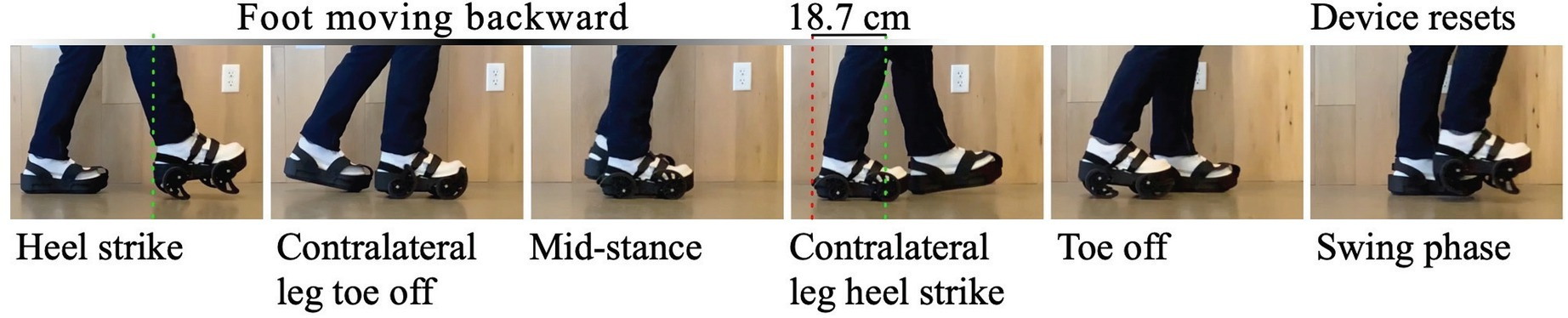 |
The evergait™ Go is engineered to alter interlimb coordination without the need for external power. Its mechanical design converts the wearer's downward and horizontal forces into a controlled backward motion of the foot. The device is lightweight and mobile, allowing gait training to move beyond stationary rehabilitation equipment and into overground environments.
Motion sensors, app, and remote monitoring
The commercial evergait™ Go system is being developed with wearable motion sensors and a connected app. The sensors record steps and walking-pattern data during sessions so that the patient's rehabilitation therapist can review treatment activity and progress remotely. The clinician dashboard is in development. For the current description of the sensor and software system, visit evergait.com.
Results of walking on the evergait™ Go
This is one participant from our study. Before treatment, the participant was several years post-stroke and had completed traditional rehabilitation. He then completed 12 sessions of walking on the evergait™ Go for 30 minutes per session. We followed up with the participant at several timepoints over the year after treatment ended. The video shows his gait before treatment and at follow-up timepoints after treatment, illustrating the changes observed in this participant and their persistence over time.
Key Features and Benefits
- Natural Over-Ground Walking: The evergait™ Go mimics the effects of split-belt treadmill therapy while walking over ground, ensuring that users experience consistent sensory information. This natural walking experience aids in the effective transfer and retention of improved walking patterns to real-world environments.
- Mechanical, Power-Free Design: The evergait™ Go requires no external power source. It mechanically harnesses the wearer's own forces to generate the necessary motion, making it a lightweight and user-friendly option for gait rehabilitation.
- Home-Based Rehabilitation: By enabling use outside the clinic, the evergait™ Go allows walking practice to continue in the home environment rather than being limited to clinic-based equipment.
- Cost-Effective Solution: The evergait™ Go is significantly less expensive than traditional split-belt treadmills, making it accessible for both clinical and home-based rehabilitation. Its affordability allows more individuals to benefit from advanced gait training without the financial burden associated with other high-cost rehabilitation technologies.
- Controlled Mechanical Motion: The device incorporates rotary dampers to provide smooth, controlled backward foot motion during stance.
- Published Clinical Research: Peer-reviewed pilot, feasibility, home-use, telehealth, and long-term follow-up studies have reported improvements in gait and functional outcomes in stroke survivors. The clinical studies to date were single-group studies without a control group and used earlier versions of the device; individual results may vary.
Summary
The evergait™ Go is a portable, passive gait rehabilitation device designed to bring gait-adaptation training from specialized equipment into overground walking. Research at the USF REED Lab has evaluated earlier versions of the technology in clinic, home, and telehealth settings after stroke, including long-term follow-up studies. The commercial evergait™ Go system is being developed for clinic setup followed by continued rehabilitation at home, with wearable sensors and connected software intended to allow therapists to review treatment activity and walking data remotely.
Research on the technology began at the REED Lab at the University of South Florida in 2009. Earlier versions were known as the Gait Enhancing Mobile Shoe (GEMS) and later the iStride™ Device. evergait, LLC was formed in 2025 to commercialize the next generation of the technology as evergait™ Go under an exclusive license from the University of South Florida.
Current product and commercialization information: The official source for availability, clinical inquiries, regulatory status, and the commercial evergait™ Go system is www.evergait.com.
Recognition
- 2026 Tampa Bay Inno Awards: Healthtech Honoree
- 2026 Tampa Bay Tech Awards: Finalist, Emerging Tech Company of the Year
Current company news and recognition are maintained at evergait.com.
Research and commercial status
The research described on this page includes earlier versions of the technology and was conducted in research settings. evergait™ Go is not yet available for sale. In a September 3, 2026 response to a Section 513(g) request, FDA advised that evergait™ Go falls within 21 CFR 890.5360, Measuring Exercise Equipment, a Class II device type exempt from 510(k) premarket notification, subject to applicable limitations. A 513(g) response is not FDA clearance or approval. For current regulatory and commercialization status, see evergait.com.
Frequently Asked Questions
What is evergait™ Go?
evergait™ Go is a portable, passive gait rehabilitation device developed from research at the University of South Florida REED Lab. It is designed to bring principles of split-belt treadmill gait adaptation to overground walking.
How does evergait™ Go work?
Four kinetic-shape wheels worn on the unaffected side move the foot backward during stance, creating a controlled gait perturbation while the user walks over ground. The device is mechanical and does not require external power.
Who developed evergait™ Go?
The technology originated at the REED Lab at the University of South Florida. Research began in 2009, and evergait, LLC was formed in 2025 to commercialize the next generation of the technology under an exclusive license from USF.
What is the relationship between GEMS, iStride™, and evergait™ Go?
GEMS (Gait Enhancing Mobile Shoe) was the original research name for the technology. Earlier clinical studies evaluated versions later known as the iStride™ Device. evergait™ Go is the next generation being commercialized by evergait, LLC.
Where can patients, rehabilitation clinics, and others learn more about evergait™ Go?
For current product information, availability, clinical inquiries, and commercialization updates, visit the official evergait website at evergait.com.
Related Publications
- B. Darcy, L. Rashford, D. Huizenga, K.B. Reed, and S.J.M. Bamberg, "Balance Improvement and Fall Risk Reduction in Stroke Survivors After Treatment With a Wearable Home-Use Gait Device: Single-Arm Longitudinal Study With 1-Year Follow-Up," JMIR Formative Research, vol. 9, 2025.
[ JMIR ] - B. Darcy, L. Rashford, N.T. Tsai, D. Huizenga, K.B. Reed, and S.J.M. Bamberg, "One-year retention of gait speed improvement in stroke survivors after treatment with a wearable home-use gait device," Frontiers in Neurology, vol. 14, 2024. doi: 10.3389/fneur.2023.1089083
[ frontiers ] - B. Darcy, L. Rashford, S. T. Shultz, N. T. Tsai, D. Huizenga, K. B. Reed, and S. J. Bamberg, "Gait device treatment using telehealth for individuals with stroke during the covid-19 pandemic: Nonrandomized pilot feasibility study," JMIR Formative Research, vol. 7, no. 1, p. e43008, 2023.
[ JMIR ] - D. Huizenga, L. Rashford, B. Darcy, E. Lundin, R. Medas, S. T. Shultz, E. DuBose, and K. B. Reed, "Wearable gait device for stroke gait rehabilitation at home," Topics in Stroke Rehabilitation, 2021.
[ Taylor & Francis Online ] - D. Huizenga, B. Darcy, L. Rashford, E. Lundin, R. Medas, S.T. Shultz, E. DuBose, K.B. Reed. "Home Use Gait Device for Stroke Hemiparesis: Long-Term Follow-Up Results", in Archives of Physical Medicine and Rehabilitation, v. 101, issue 11, p. e68, 2020.
- B. Darcy, L. Rashford, E. Lundin, R. Medas, T. Shultz, E. DuBose, D. Huizenga, K. B. Reed. "Active Limb Orthosis for Home Use-Stroke Gait Rehabilitation", Combined Sections Meeting (CSM), APTA, February 2020.
[ APTA ] - B. Darcy, L. Rashford, E. Lundin, R. Medas, T. Shultz, E. DuBose, D. Huizenga, K. B. Reed. "The Relationship Between Gait Speed and Self-Reported Quality of Life in Stroke Survivors After Treatment With a Therapeutic Gait Device", Stroke, February 2020.
[ Stroke ] - L. Rashford, B. Darcy, E. Lundin, R. Medas, T. Shultz, E. DuBose, D. Huizenga, K. B. Reed. "Active Limb Orthosis for Home Use - Stroke Gait Rehabilitation", American Congress of Rehabilitation Medicine (ACRM), November 2019.
[ ACRM ] - S. Kim, D. Huizenga, I. Handzic, R. Ditwiler, M. Lazinski, T. Ramakrishnan, A. Bozeman, D. Rose, K. B. Reed. "Relearning functional and symmetric walking after stroke using a wearable device: a feasibility study," Journal of NeuroEngineering and Rehabilitation, Volume 16, 2019.
[ Springer Nature ] - S. H. Kim, D. Huizenga, I. Handzic, R. Edgeworth, M. Lazinski, T. Ramakrishnan, D. Rose, K. B. Reed. "Device for Improving Double Limb Support, Step Length Symmetry, and Gait Speed in Hemiparetic Patients", in Archives of Physical Medicine and Rehabilitation, v. 98, issue 10, p. e52
[ Archives PMR ] - S. H. Kim, I. Handzic, D. Huizenga, R. Edgeworth, M. Lazinski, T. Ramakrishnan, and K. B. Reed. "Initial Results of the Gait Enhancing Mobile Shoe on Individuals with Stroke," in Intl. Conf. of the IEEE Engineering in Medicine and Biology Society (EMBC), Orlando, USA, 2016.
[ EMBC ] - "Gait-Altering Shoe," K. B. Reed and I. Handzic, U.S. Patent 9,295,302, issued March 29, 2016, priority date February 17, 2012.
[ USPTO ] - I. Handzic and K. B. Reed. "Kinetic Shapes: Analysis, Verification, and Applications," ASME Journal of Mechanical Design, Vol. 136, No. 6, pp. 061005(1-8), 2014.
[ ASME | ASME | abstract ] - I. Handzic and K. B. Reed, "Comparison of the Passive Dynamics of Walking on Ground, Tied-belt and Split-belt Treadmills, and via the Gait Enhancing Mobile Shoe," Proc. of the 13th Intl. Conf. on Rehabilitation Robotics (ICORR), Seattle, USA, June, 2013.
[ ICORR ] - I. Handzic, E. Vasudevan, and K. B. Reed, "Developing a Gait Enhancing Mobile Shoe to Alter Over-Ground Walking Coordination," Proc. of IEEE Intl. Conf. on Robotics and Automation (ICRA), St. Paul, USA, May, 2012.
[ ICRA | .mp4] - I. Handzic, E. Barno, E. V. Vasudevan, and K. B. Reed. "Design and Pilot Study of a Gait Enhancing Mobile Shoe," Journal of Behavioral Robotics, Special Issue on Assistive Robotics, Vol. 2, Num. 4, pp. 193-201, 2011.
[ SpringerLink | preprint | PubMed | abstract ] - I. Handzic, E. Vasudevan, and K. B. Reed, "Motion Controlled Gait Enhancing Mobile Shoe for Rehabilitation," Proc. of the 12th Intl. Conf. on Rehabilitation Robotics (ICORR), Zurich, Switzerland, June, 2011.
[ ICORR | .mp4 | PubMed ] - A. de Groot, R. Decker, and K. B. Reed. "Gait Enhancing Mobile Shoe for Rehabilitation," Third Joint Eurohaptics Conference and Symposium on Haptic Interfaces for Virtual Environment and Teleoperator Systems (World Haptics), Salt Lake City, USA, 2009.
[ World Haptics | .mp4 ]
- "Stroke therapy shoe invented at USF empowers patients' recovery"
https://www.usf.edu/news/2024/stroke-therapy-shoe-invented-at-empowers-patients-recovery.aspx - "Stroke shoe retrains the brain, correcting gait"
https://www.wndu.com/content/news/Stroke-shoe-retrains-the-brain-correcting-gait-506721291.html - "Early study shows shoe attachment can help stroke patients improve their gait"
https://medicalxpress.com/news/2017-12-early-patients-gait.html - "Shoe offers stroke recovery revolution"
http://www.fox13news.com/health/shoe-offers-stroke-recovery-revolution - "Early study shows new shoe attachment can help stroke patients improve their gait"
https://hscweb3.hsc.usf.edu/blog/2017/12/13/early-study-shows-new-shoe-attachment-can-help-stroke-patients-improve-gait/ - "Spirals inspire walking aids for people with disabilities"
https://www.sciencenews.org/article/spirals-inspire-walking-aids-people-disabilities
This work has been funded by the Eunice Kennedy Shriver National Institute of Child Health & Human Development (NIH NICHD award #R21HD066200) and the Florida High Tech Corridor.